
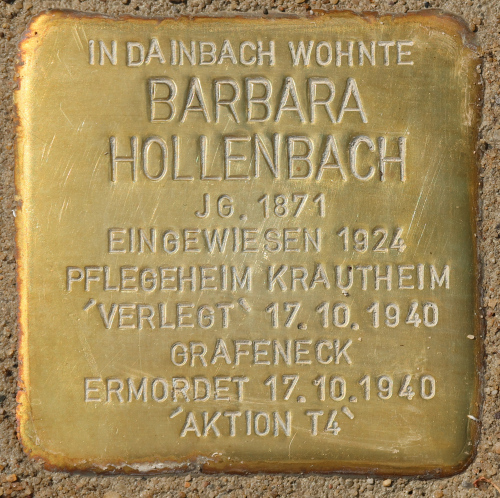
Barbara Hollenbach
Kannengasse 55
Barbara Philippina Katharina Hollenbach, to give her full name, was born in Dainbach. She was born on 8 January 1871 on the farm of the farmer Johann Hollenbach and his wife Margaretha (née Ulshöfer). We know nothing more today about her childhood and youth, but in 1904 Barbara Hollenbach’s name appears in the records of the municipality of Dainbach.
In September 1904, her odyssey through various clinics and institutions began. On the 21st of that month, Barbara Hollenbach was admitted to the ‘Badische Universitäts-Irrenklinik’ (Baden University Mental Hospital) in Heidelberg, where she remained until 13 February 1905. A good year later, on 24 March 1906, she was declared legally incompetent. We do not know when she returned to Heidelberg, but the Dainbach municipal archives contain a record indicating that she was transferred from Heidelberg to the Wiesloch Sanatorium on 9 March 1909. This was followed in July 1914 by another stay at a clinic in Heidelberg. By the end of the year, on 30 December 1914, she was back in Wiesloch. As she no longer required further psychiatric treatment, Barbara Hollenbach was transferred to the Krautheim State Poorhouse on 16 April 1924.
Barbara Hollenbach lived in Krautheim until 17 October 1940. On that day, she was one of 50 residents who were taken to Grafeneck in a ‘grey bus’. She was murdered in Grafeneck on the very same day.
In total, 56 sick and disabled residents were deported from Krautheim as part of Operation T4. 52 patients were murdered in the extermination centres at Grafeneck and Hadamar, two more in Zwiefalten; only two residents survived.
Unfortunately, we were unable to determine Barbara Hollenbach’s place of residence, so the site in front of the church was used as the location for the memorial.
Laying date: June 19. 2026
Sponsorship: none
Author: RH